How can tourism destinations reduce waste and better manage resources through circular design AND supporting local livelihoods?
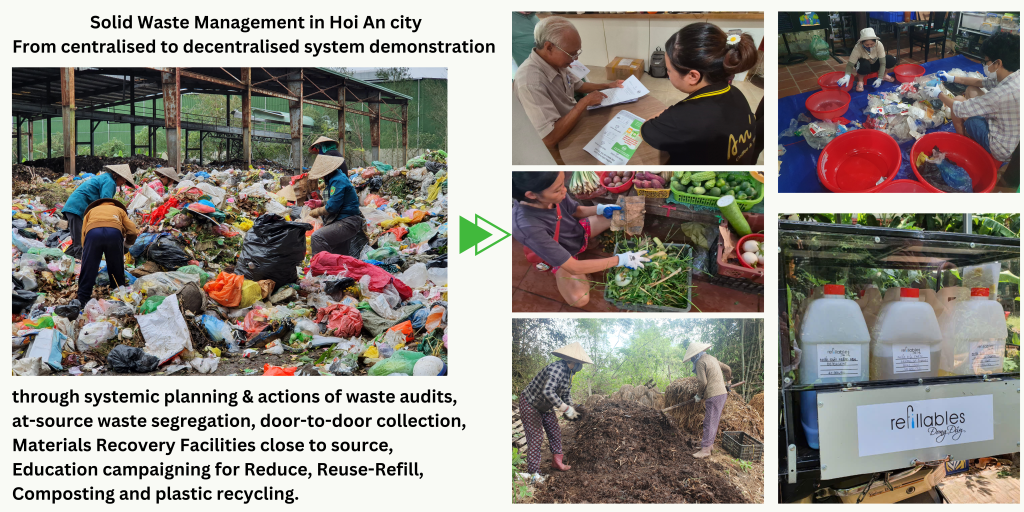
Tourism destinations face a growing challenge: increasing visitor numbers bring economic opportunities, but also place pressure on waste management systems, local environment, and communities. In many destinations, waste—especially single-use plastics and organic waste—accumulates faster than existing systems can manage.
Responding to this challenge requires more than technical fixes. It calls for coordination across businesses, communities, and local institutions, and solutions that can be sustained over time.
REED works at this intersection, focusing on practical pathways toward zero waste and circular resource use in tourism destinations.
Zero waste in tourism as a system challenge
In tourism context, waste is shaped by interconnected factors: business operations, supply chains, visitor behavior, local infrastructure, and informal labor systems. As a result, isolated actions by individual businesses—while important—are rarely sufficient on their own.
REED approaches zero waste as a system design and transition process, focusing on how different actors within a destination can gradually align their practices toward shared goals.
The emergence and role of REED in Hội An
Since 2020, REED has worked closely with tourism and hospitality businesses in Hội An to translate waste reduction commitments into practical, day-to-day operations. Initial engagement focused at the business level, supporting hotels, restaurants, and tourism operators through waste audits, action planning, staff training, and the introduction of measures to reduce single-use plastics and improve source separation.
As this work progressed, engagement expanded beyond individual businesses into destination-level collaboration. REED worked alongside local authorities, provincial tourism association, donors, solution providers, and community groups to help form a Waste Solution Network, a game changer approach in sustainable waste management in Hoi An.
Despite disruptions caused by COVID-19, these efforts continued through ongoing public–private dialogue and partnerships with technical organizations and donors. This sustained process demonstrated that coordinated, incremental action—coordinated and led by a locally based intermediary organisation – can support the transition toward a more sustainable tourism destination, grounded in local capacity and collaboration.
By operating zero waste system as social enterprise model, REED demonstrates that decentralised, locally operated solutions can:
- Reduce municipal costs related to landfill and waste transportation
- Create green jobs for youth, women, and informal workers
- Supply local farmers with quality compost and soil amendments
- Strengthen destination branding through credible environmental practice
Insights from these demonstrations have contributed to:
- Voluntary commitments from 50+ tourism businesses to implement waste and plastic reduction practices, adopting measures such as reusable water systems, refillable bathroom amenities, on-site organic waste treatment, and participation in shared training and peer-learning programs.
- Engagement with 100+ hotels, restaurants, and tour operators through audits, training, and technical support
- Technical input into local strategies and guidelines for plastic-free and zero waste tourism in Quảng Nam and Hội An and other tourism destinations in Vietnam (Phu Yen, Con Dao, Hue)
Several early adopters within the network that REED supports technically have since been recognised for their efforts, helping to normalise zero waste practices within the hospitality sector. (The Field Hoi An restaurant, Silk Sense Hoi An, An Villa, EMM Hotel…).
Visit our Youtube channel for more details of the network of actions, change makers and collaborations we’ve created in Hoi An city.
From waste reduction to circular resource use
Building on this foundation, REED’s work emphasizes moving beyond waste reduction toward circular use of resources within tourism destinations. This includes:
- Redirecting organic waste into local composting and soil regeneration systems
- Introducing reuse and refill systems to replace disposable items
- Connecting reusable or recoverable materials with local repair, refurbishment, or redistribution pathways
These practices help reduce landfill pressure while strengthening local circular economies.
Linking zero waste with livelihoods and climate actions
Waste management is closely tied to informal work and small-scale livelihoods. REED integrates social considerations into zero waste initiatives by:
- Supporting local service providers and micro-enterprises
- Developing skills related to reuse, composting, and material recovery
- Aligning waste solutions with climate-adaptive livelihood strategies
This approach recognizes that long-term waste reduction is more likely to succeed when it also supports economic resilience and local ownership.
Working with destinations, not just businesses
While direct support to tourism businesses remains central, REED’s destination-level approach prioritizes:
- Peer learning and collective commitment among businesses
- Alignment with local government strategies
- Collaboration with community-based initiatives and solution providers
This enables change to spread across a destination in a gradual and practical way, rather than remaining limited to early adopters.
What this work aims to demonstrate
- Demonstrate that zero waste transitions are achievable through step-by-step practice
- Show how tourism can reduce greenhouse gas emission through zero waste actions while contributing positively to local systems
- Offer adaptable examples that other destinations can learn from
Through long-term engagement and grounded practice, REED contributes to tourism transitions that are environmentally responsible, culturally appropriate and economic viability.
 Vietnam's Community Schools for Regeneration