Introduction
Planting on Demand’s mission is to empower small-scale farmers and local communities in the Global South by facilitating their leadership in sustainable tree-planting initiatives. By supporting the integration of food-producing trees into agricultural systems, we enable communities to build their resilience, diversify their economies, and enhance their environments. This bottom-up approach ensures that the drive to prevent deforestation and mitigate climate change is locally led and globally supported.
Planting on Demand and Green Youth Collective has become partners since early 2025. Watch our first live tree planting session in this video.

Travellers joined planting trees with local villagers.
The interview below is the further exploration to see tree planting as a form of commons.
- Please introduce yourself and tell us a bit about your organization
My name is Hanh Vu and I am the Director of Green Youth Collective.
We are a community-based social enterprise based in Hội An, Central Vietnam, with over 10 years of experience working across the city and surrounding regions.
At Green Youth Collective (GYC), our work centers around three key areas:
#1. Resource Management and Zero Waste
Our journey began by partnering with hospitality businesses to reduce waste and repurpose discarded materials for environmental benefit and community support. As we became part of the broader zero waste movement—both within Vietnam and internationally—we embraced a systems-change approach. This allows us to implement zero waste practices at the community level in a way that’s practical, inclusive, and impactful.
#2. Closed-Loop and Integrated Farming
This work is deeply connected to our zero waste efforts, focusing on household and village-scale agriculture. We envision a future where more people return to growing food naturally and non-toxically—honoring the health of ourselves, others, and the Earth. Integrated farming draws from nature’s wisdom: creating living systems where soil, plants, animals, and humans support one another in a harmonious, circular flow. It’s an approach rooted in biodiversity, balance, and interdependence.
#3. Education and Training for Resilience and Regeneration
Our core mission is to support local communities in building the knowledge, skills, and values needed to preserve their cultural identity and strengthen resilience in the face of climate change, pollution, and social or economic injustice. We work with local changemakers—government officials, business owners, women, youth, and vulnerable groups such as farmers and waste workers—helping them transition to green, sustainable livelihoods. This includes initiatives like operating community composting sites, managing ecological nurseries, and cultivating useful trees for land restoration.
Beyond the local context, our learning centers and community schools also welcome learners from all walks of life—both from Vietnam and around the world. Here, they can be inspired and equipped to take part in regenerative development in their own homes, communities, and workplaces.
2. Why do you care about planting trees, and can you share a moment when you felt proud of your work?
When I first moved to Central Vietnam nearly 20 years ago to work on climate change and community-based resilience, I was deeply struck by how vulnerable local communities are to natural disasters and environmental instability. But over time, I realized that these vulnerabilities aren’t just caused by nature—they’re often worsened by human choices. Alongside rapid tourism growth and urbanization, there has been a lack of long-term vision and concrete care for the land.
At Green Youth Collective, we’ve come to experience, both personally and collectively, the profound value of planting trees. Living on the land grounds me. I work with my hands in the soil, shoulder to shoulder with like-minded friends—building gardens, restoring land, and yes, always planting trees. There’s a unique joy that comes from planting a tree, watering it, and watching it grow season after season.
Of course, we’ve also experienced loss—trees swept away by floods, scorched by dry seasons, or broken by storms. But those moments haven’t discouraged us. If anything, they’ve deepened our faith in the work. As a community, we keep planting, keep healing the land, and keep growing together.
There are countless moments that move me, but one especially close to my heart is having my son—and now, another baby growing inside me—join us on tree planting days. Watching his tiny feet walk the land under the sun, surrounded by farmers and young people learning the regenerative way, fills me with quiet joy. To me, that’s education at its best: the land, the village, the trees, and the spirit of working together.
As a mother, a partner, an activist, and a community leader, I feel most alive in these moments—where different elements of life come together in harmony, purpose, and hope.
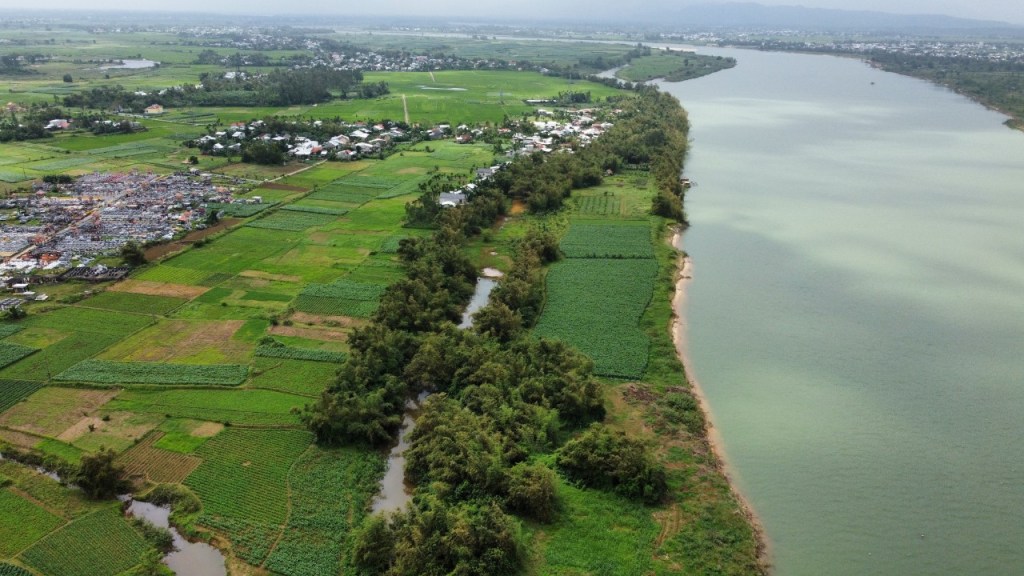
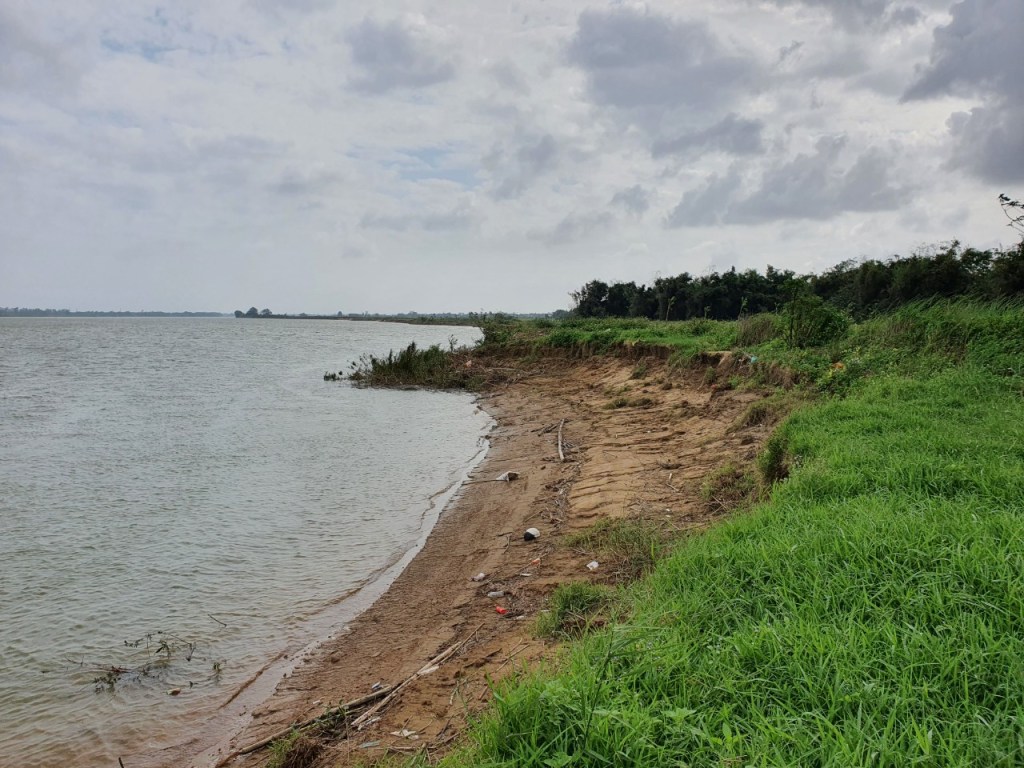
Green Youth Collective’s planting sites and local villagers have suffered from soil erosion, unpredictable heat waves and typhoons.
3. Can you explain the benefits of planting several tree species (agroforestry approach) and how this supports communities?
Nature shows us that diversity is the foundation of resilience and abundance. At Green Youth Collective, we always turn to nature for guidance—in how we plant trees, restore land, and design sustainable livelihoods. In this spirit, agroforestry—planting multiple tree species together—is not just a farming technique, but a philosophy of living in harmony with the Earth.
When farmers grow a variety of trees, they gain access to a wide range of resources: fruits, timber, herbs, and medicinal plants that serve both daily needs and economic purposes. At the same time, this approach enriches the entire ecosystem. Diverse tree species create habitats for birds, insects, and microorganisms—above and below the soil—each playing a role in maintaining balance and fertility. Without this web of life, true healing of the land is not possible.
Beyond the tangible harvest, agroforestry regenerates the soil, protects against erosion, retains water, and builds long-term fertility. It supports ongoing food production and strengthens the bond between people and their ancestral land. In doing so, it helps preserve not only the environment, but also the heritage, identity, and living culture of rural communities.
Agroforestry is not just about planting trees—it’s about planting hope, resilience, and connection for generations to come.
4. How are farmers or community members involved in your planting work, from planning and decision making to welcoming new participants?
Farmers and local community members are at the heart of our planting work. They participate both formally and informally. Formally, we collaborate with local government and the village’s agricultural and tourism cooperative to co-design and implement planting initiatives. Informally, farmers engage through project-based activities—such as receiving training, supporting seedling care in our Ecological Tree Nursery, and joining planting days when resources and timing allow.
Given the region’s unpredictable and sometimes extreme climate conditions, planting isn’t something we can do year-round. Careful planning is required to align with the rhythms of the land and weather. This means we often work closely with farmers to choose the right planting seasons, prepare the soil, and select the right species that are both ecologically suitable and culturally meaningful.
We also create space for new participants—whether they are local youth, traveling visitors, or volunteers—to join the process, learn alongside experienced farmers, and become part of a growing community rooted in care for the land.
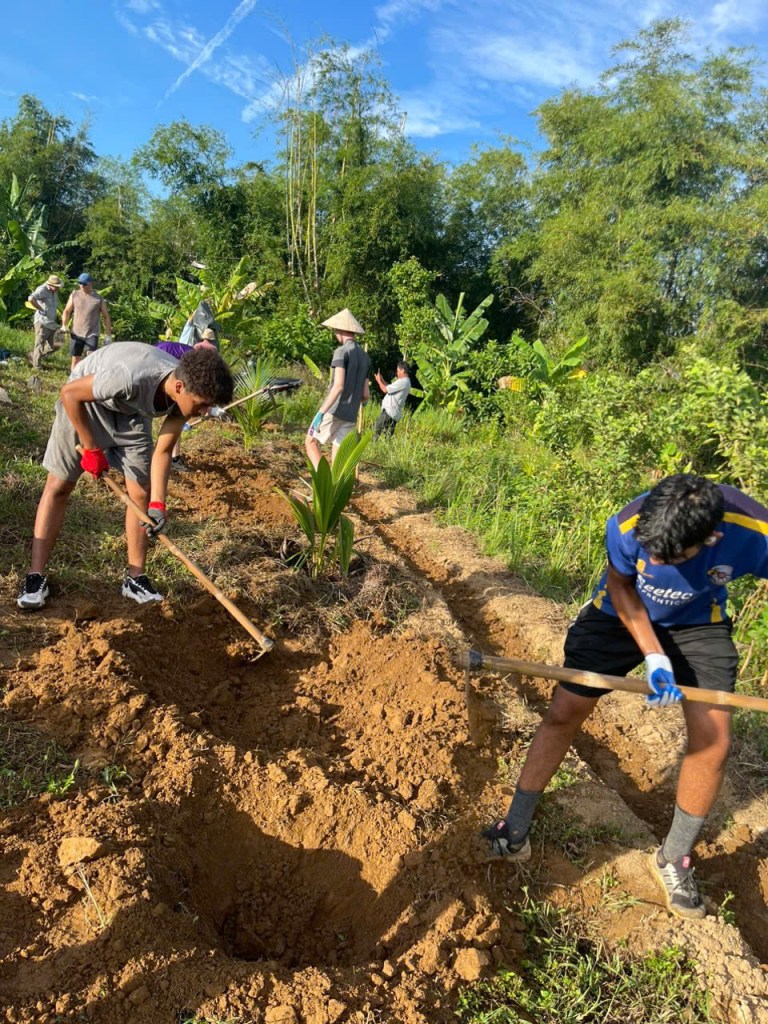
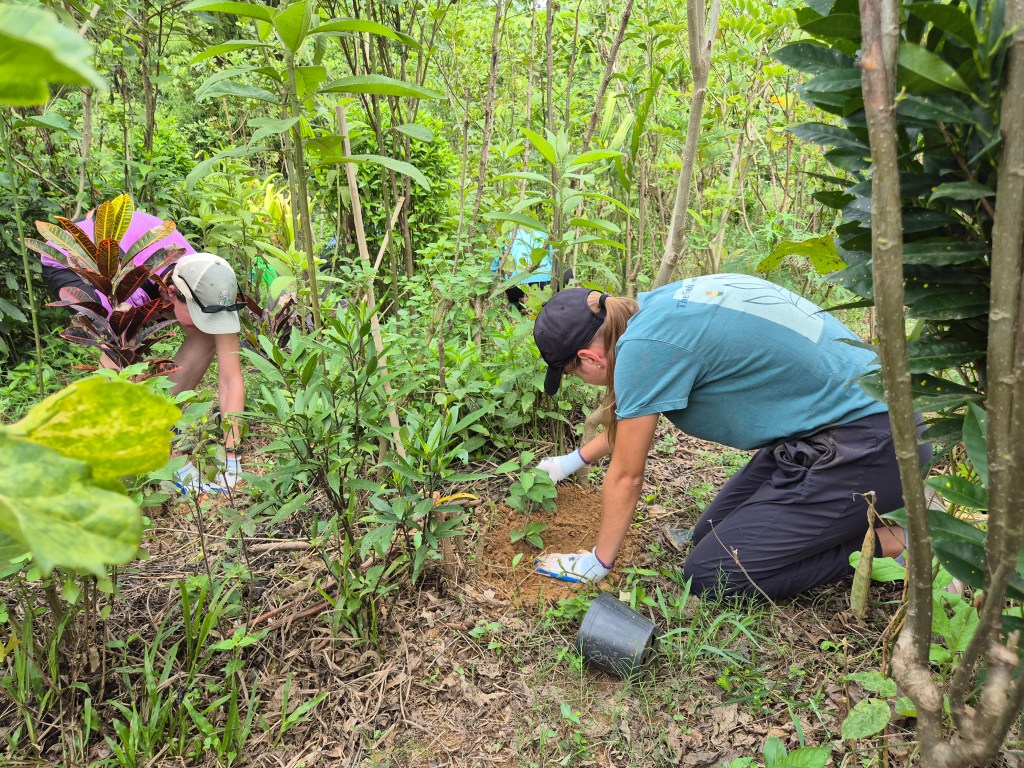
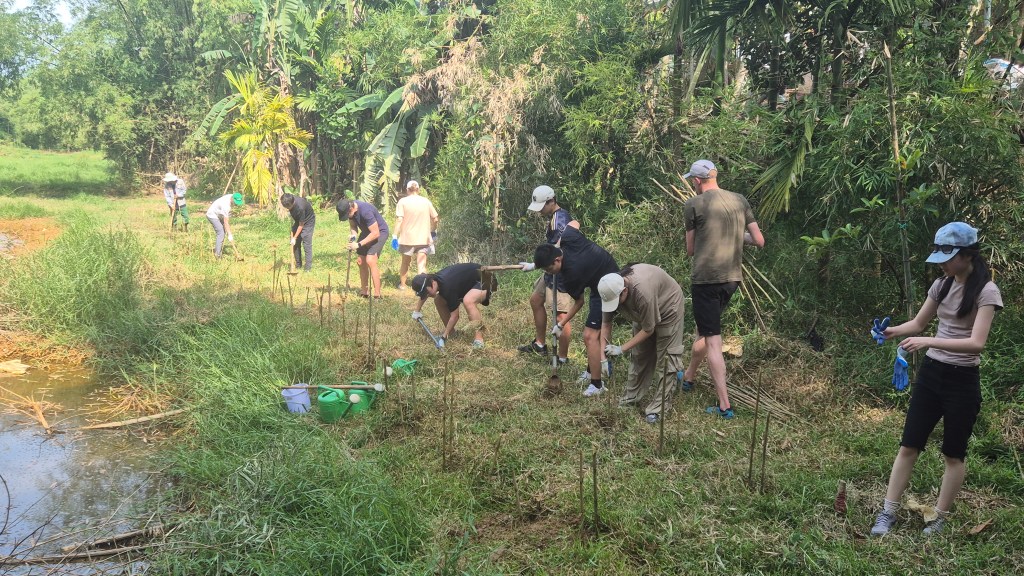
Travelers and learners from all over the world love regenerative experiences they have with our community.
5. Who benefits from the trees you plant, and how are those benefits typically shared? For example, are harvests consumed locally, sold in markets or distributed in another way?
It’s still early to fully measure the long-term outcomes of our tree-planting work, especially in terms of harvest. However, from the beginning, we’ve made it a priority to ensure fairness and inclusivity in how the benefits are shared. Farmers who participate in our projects are paid fair wages for their time and labor. At the same time, much of the effort also comes from dedicated volunteers—our staff, cooperative members, and community residents—who share a deep belief in the future of the land and its potential.
The planting site itself is located on communal land, managed by the village cooperative. It remains open and accessible to everyone in the village. People use the area not only for recreation but also for practical purposes—such as fishing, aquaculture, or collecting natural materials to support their livestock. So even before the trees begin to yield fruit or wood, the value of the land is already being felt and shared: through shade, natural beauty, biodiversity, and a stronger connection to the land.
Ultimately, the trees we plant belong to the community—not just in ownership, but in spirit. The benefits, both tangible and intangible, are meant to be experienced by all who live in or visit this place.
6. How do you decide which tree species to plant? Do these choices reflect local traditions, ecological conditions or community needs?
Our decisions are based on all three: local traditions, ecological conditions, and community needs. Over the past decade of living, gardening, and planting trees in this region, we’ve learned that native species—those most commonly seen in local landscapes—are often the most resilient. They require minimal inputs, thrive in tough conditions, and hold deep cultural and ecological value. These species have long histories with the land and the people, and the local knowledge around how to use them—for food, medicine, windbreaks, and more—is rich and meaningful.
Preserving that intergenerational wisdom is central to our mission. The practices of older generations, who once relied on these plants to survive through hardship, are something we deeply respect and hope to pass on to younger generations through hands-on education and community engagement.
At the same time, we recognize that today’s farming conditions have changed. To support current and future generations in staying connected to their land, we also look for species that are adaptable and aligned with modern needs and available resources.
We maintain a growing list of tree and plant species that we’ve tested and observed over time—building practical, on-the-ground knowledge that helps us choose the right species for each context. Our approach is not static; it’s always evolving with the land, the people, and the times.
7. What challenges do communities face in caring for trees long term, and how do you support them in ensuring tree survival and growth?
One of the biggest challenges communities face is ensuring long-term tree survival under harsh environmental conditions—such as poor soil, extreme weather, and limited access to water and resources. To address this, our strategy is to start small, work gradually, and let nature guide us.
Before planting any trees, we focus on building healthy soil. In the first few years, we prepare the land through green manuring, growing deep-rooted pioneer species, composting, and recycling organic materials on site. A strong foundation of living soil is essential for any tree to thrive.
Another key element of our strategy is maintaining an on-site Ecological Tree Nursery. This allows us to raise seedlings in a nurturing environment, carefully preparing them to withstand the tough conditions they’ll face once planted in the field. The nursery is a space of learning, adaptation, and care—ensuring that trees are not just planted, but are truly ready to grow.
We also apply regenerative techniques such as mulching, cover cropping, moisture retention pits, and natural nutrient cycling to support young trees. These practices help retain soil moisture, improve fertility, and protect trees from climate stress.
Ultimately, long-term success comes from working with—not against—nature, and from empowering communities with the tools, knowledge, and care needed to steward the land sustainably.

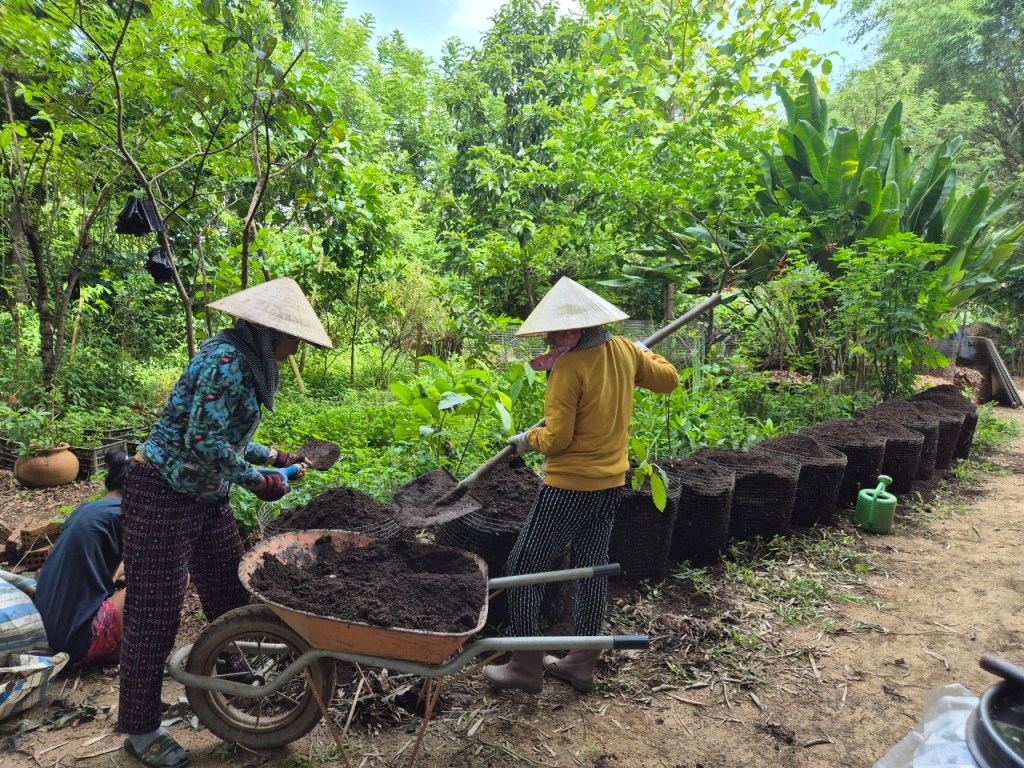
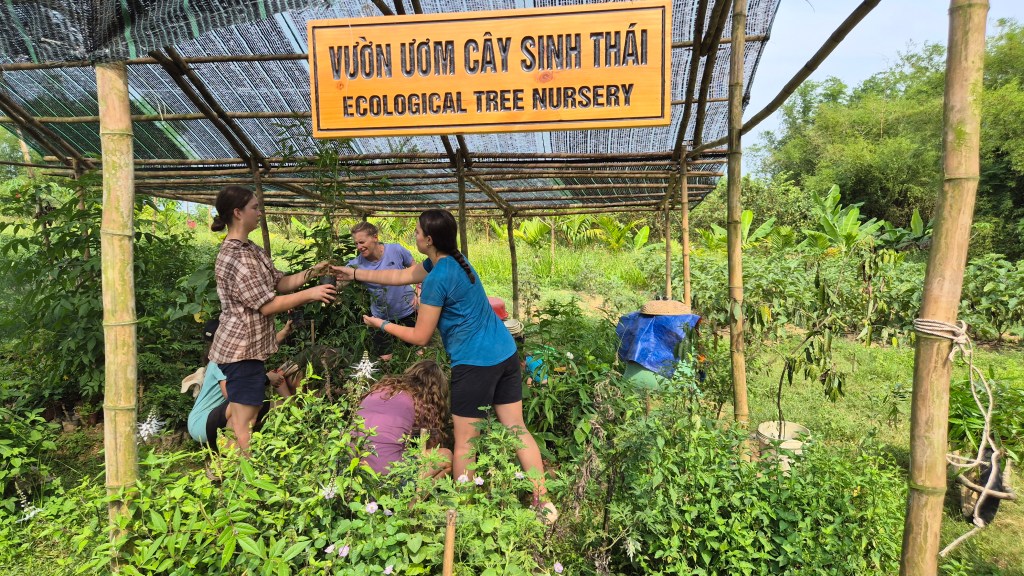
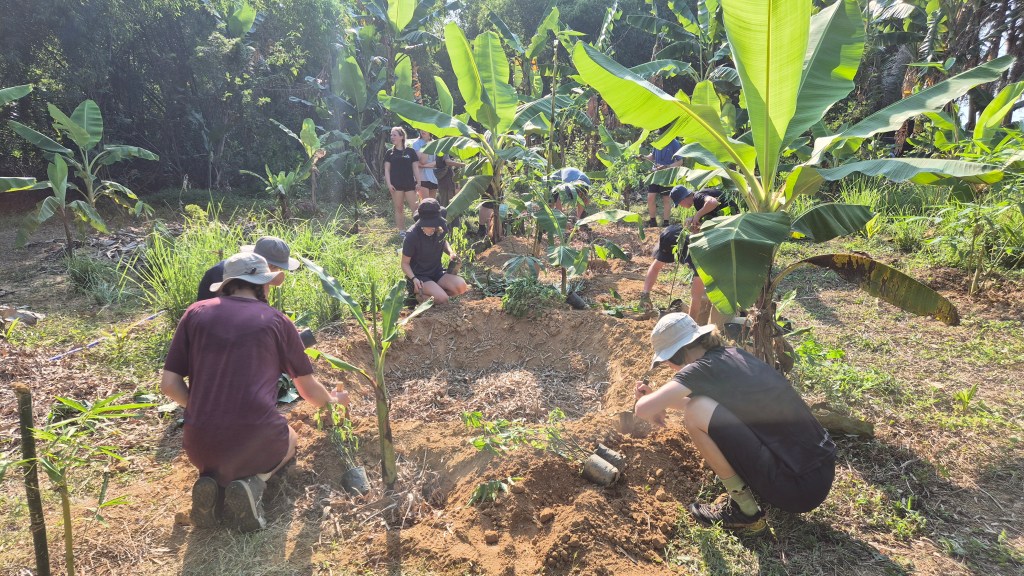
Green Youth Collective pioneers in incorporating municipal organic waste transformation into community land restoration. Waste –> Compost –> Tree Nurseries –> Tree Planting.
8. How do you motivate farmers or groups to integrate trees into their farming systems, especially when the benefits take time to appear?
We begin by showing—not just telling. By pioneering integrated tree-based farming systems ourselves, we offer a living, working model for others to observe. Step by step, we involve farmers through hands-on activities so they can witness the benefits with their own eyes: healthier soil, improved microclimates, and the long-term potential for diversified income and food sources.
We also make sure practical support is available when they’re ready to act. This includes providing ready-to-use compost and well-prepared seedlings from our Tree Nursery, so farmers feel confident and equipped to begin. Alongside this, we offer informal training and share techniques during daily interactions, in a way that feels natural and community-centered.
Another powerful motivator is the cultural exchange that happens when we host learners and volunteers from around the world. When international visitors come to join in planting and composting activities, it often sparks curiosity and pride among local farmers. These moments show that their work and traditional knowledge are not only valuable—but also respected and celebrated globally.
Through these layered approaches—demonstration, practical support, shared learning, and intercultural experience—we help shift the mindset from short-term thinking to long-term care, and cultivate a deeper connection to regenerative practices.
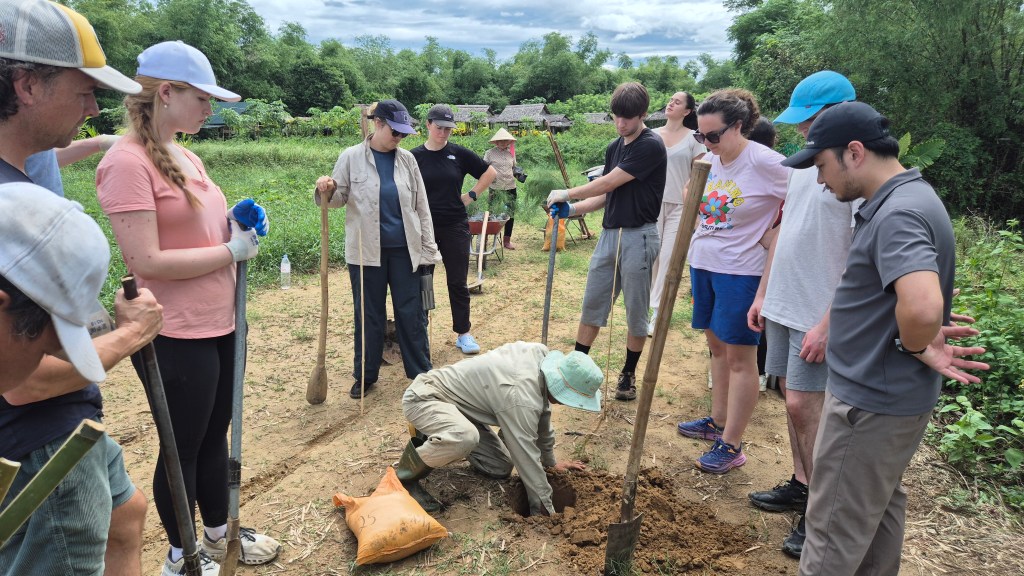
Traveling visitors and learners from all over the world are guided in tree planting by farmers and villagers. Our people become instructors and feel proud about planting trees.
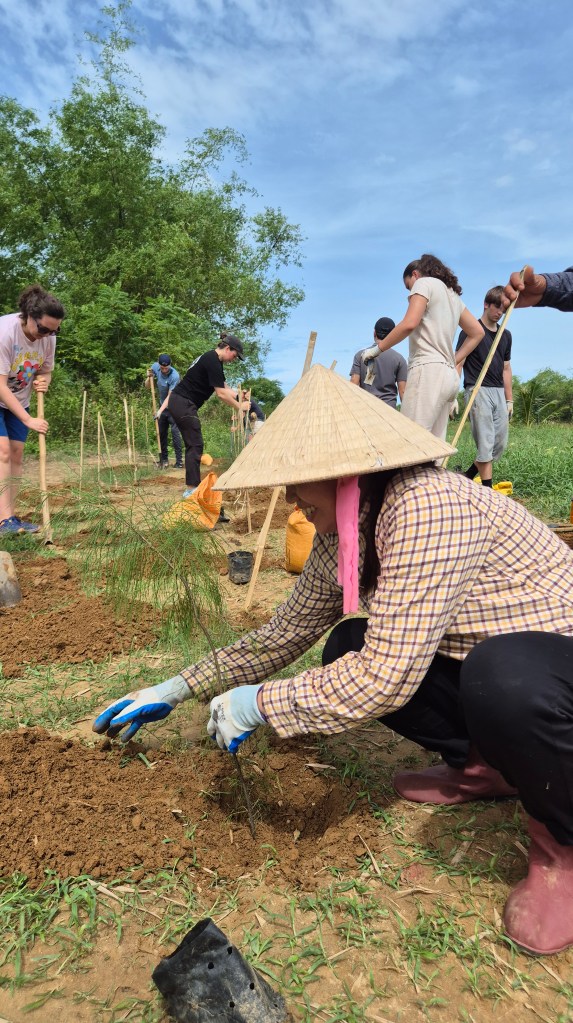
 Vietnam's Community Schools for Regeneration