(The story was written as requested by the Vietnam Environmental and Marine Sciences Institute, under the Ministry of Agriculture and Environment of Vietnam, for the official guidebook supporting nationwide implementation of the 2020 Environmental Law on waste segregation and organic waste treatment.)
Many visitors are genuinely surprised when they enter the Material Recovery Facility of Green Youth Collective in Hội An. The space stands in stark contrast to what people often imagine when thinking of a place that gathers and processes waste—especially organic waste, which is typically associated with unpleasant smells and pollution.
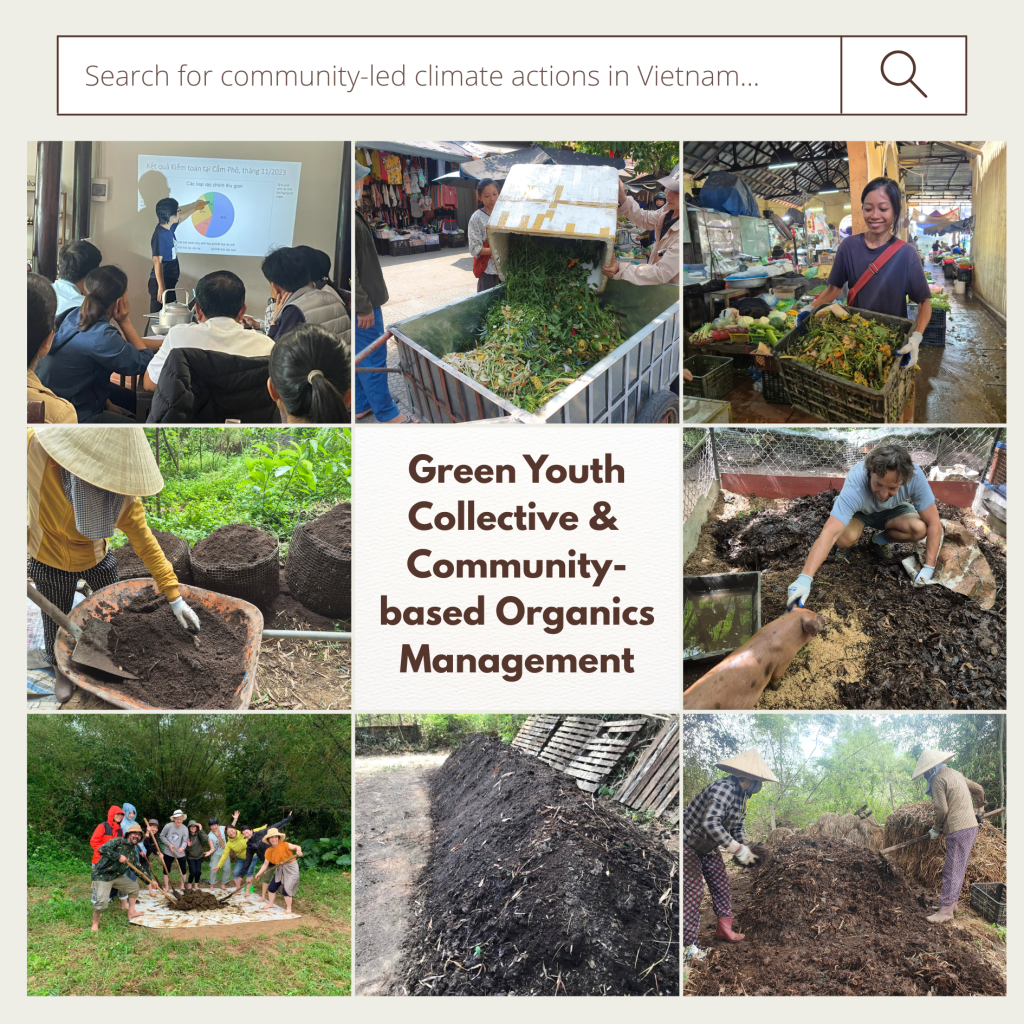
Instead, when stepping into the Hoi An Eco Hub, visitors are welcomed by the shade of large trees and the peaceful atmosphere of an urban farm. Chickens and piglets enthusiastically scratch through compost piles in search of food, while farmers and waste workers chat and tease one another as they work. Their laughter fills the air, softening the physical demands of the job and creating a sense of connection and dignity in a space many would never associate with joy.
Since 2014, Green Youth Collective—a community-based organization operating as a social enterprise—has been experimenting with and implementing nature-inspired livelihood solutions. Our focus spans Zero Waste and Resource Management, Closed-loop farming, and the Restoration of Community Agro-ecosystems.
Situated in Hội An—a heritage city where culture and tourism intersect, and where the rapid expansion of the service economy and urbanization has created mounting waste challenges—we were the pioneers who recognized early on that the 60–70 tons of organic waste generated daily is not a burden, but a vast untapped resource waiting to be transformed.
We all know that unmanaged organic waste is a major source of greenhouse gas emissions. According to Vietnam’s 2016 national GHG inventory, waste sector contributes 21 million tons of CO₂e annually—about 6.5% of the country’s total emissions. Of this, methane emissions from landfills—largely caused by anaerobic decomposition of organic waste—account for 18 million tons of CO₂e.
We also know there are simple, accessible methods to convert organic waste into soil amendments, organic fertilizers and healthy feed for animals. So why is this resource still so overlooked and underutilized?
Finding the true barriers allows us to unlock meaningful solutions. This story offers a concrete example to explore that question.
The Foundations of Community-Based Organic Waste Management
Green Youth Collective’s approach is built on several practical realities:
1. Circular use of organic waste has long existed at household and community levels.
Before urbanization, before formal waste collection services, rural households commonly fed organic scraps to livestock or buried them in garden pits. These practices, rooted in local wisdom, remain highly relevant today.
When space is limited—as in urban homes or business establishment settings—community compost stations become vital, offering nearby collection points where daily waste can be turned into useful resources.
2. A community-based system distributes responsibility and participation.
In centralized waste systems, where mixed waste is collected and sent to a concentrated landfill, responsibility lies almost solely with the local government and the Urban Environment Company or Public Works.
In contrast, a community-based model positions everyone as a responsible actor:
- Waste generators (households, restaurants, schools, markets) sort organic waste at source.
- Various cooperatives, women-led groups, youth groups, and social enterprises can take on collection, reuse, recycling, and operation of resource recovery stations and composting sites located directly within the community.
3. Waste management must function as an ecological system.
Effective circularity requires:
- Multiple complementary solutions
- A network of local stakeholders
- A full-loop system from upstream prevention to downstream recovery and reuse
- Markets that absorb end-products like compost, feed, or soil amendments
This systemic perspective is central to our work.
How the Green Youth Collective Circular Model Works

Core Principles and Distinguishing Features
1. Early sorting and close-to-source processing
Organic waste is separated at households, restaurants, schools, and collective kitchens. It is then collected and transported only short distances to the Hoi An Eco Hub or similar functional spaces.
2. Appropriate, low-cost, and easily transferable technologies
Our system mimics natural, complex, inter-connected interactions within the loop of Soil – Plants – Livestock – Fertilizer – Microorganisms – Soil.
The system requires minimal capital investment, uses locally available materials, and can be easily taught and handed over to community workers.
3. Local ownership and fair benefit-sharing
Local farmers, waste workers, women, and youth are trained to operate and manage the entire process, creating local leadership and empowerment.
4. Value creation through the circular economy
The system generates diverse products—meat, eggs, vegetables, medicinal plants, organic fertilizers, tree saplings —that return to serve local businesses and residents.
A core team of four paid workers with social insurance currently manages an average of 400-500 kg of organic waste per day.
Extending Beyond Organic Waste
Hoi An Eco Hub is more than a composting site. It is a vibrant center for circular resource recovery, handling these following materials and creating new products and services:
- Discarded single-use hotel soaps
- High-quality textile offcuts from premium hotels
- Used coffee grounds
- Used cooking oil
- Sorted recyclable plastics
- Refillables station of home-care products that help communities to access health-friendly products in eco-friendly consumption choice (this model belongs to our partner, social enterprise Refillables Dong Day)
With these initiatives, Green Youth Collective is also a local pioneer in creating circular economy models among multiple stakeholders within the hospitality and tourism sector.
Upstream Prevention and Collaborative Zero-Waste Solutions
In addition to end-point treatment, we work closely with tourism businesses to reduce waste from upstream stages—menu design, procurement, and food-use planning—to prevent avoidable food waste.
With proven results from our model, and collaboration with more than 50 tourism businesses committed to circularity, Green Youth Collective plays a central role in advancing the city’s ambition to build Hoi An – A Green Destination.
Over time, Hoi An Eco Hub has become a learning hub visited by hundreds of people in and outside Vietnam:
- Local authorities from cities across Vietnam
- National and international development organizations
- Schools and universities
- Sustainable tourism operators
- Travelers from all walks of life
Key Outcomes
- Environmental Impact
During the 2024–2025 pilot phase:
- Over 80 tons of organic waste were diverted from landfill
- 9 tons of organic fertilizers and soil amendments were produced
- More than 3,000 native and climate-resilient trees were grown for local ecosystem restoration projects in Gò Nổi
- Socio-economic Impact
- A local circular economy model now turns tourism-generated organic waste into community value.
- 5–10 local workers gain employment or supplemental income (seasonal).
- Since 2020, over 500 tourism businesses nationwide have been trained on source-separation
- Over 2,000 learners and visitors engage with the Hub annually
- Education & Sustainable Tourism
The Hub is Vietnam’s pioneering community-operated learning center run as a social enterprise specializing in zero waste and circular economy.
Sustaining the Model
The Hoi An Eco Hub demonstrates a decentralized waste management approach that:
- Operates within the community
- Is run by local people
- Strives for financial sustainability
- Empowers vulnerable groups through skill-building and meaningful participation
It offers a glimpse of a future where waste management is not an industrial afterthought, but a shared community responsibility embedded within local livelihoods and environmental stewardship.
Returning to the Central Question
So why does organic waste remain underutilized despite its immense potential?
Because the main barrier is not technology.
It lies in:
- Multi-stakeholder collaboration
- Appropriate community-level infrastructure
- The ability to adapt simple technologies to local contexts
The solution, ultimately, resides within each community itself.
Intermediary community organizations like Green Youth Collective form the essential connective tissue in decentralized systems and must be recognized, supported, and strengthened.
Sustainable waste management is, at its core, a journey of restoring the relationship between humans and the natural world—and of building new relationships among people to share responsibility, benefits, and a collective vision for a resilient future.
 Vietnam's Community Schools for Regeneration