
Designing change by learning from living systems, working upstream, and creating conditions for renewal
At Green Youth Collective (GYC), we focus on how change is designed—because the way solutions are conceived determines whether they remain fragile interventions or become living systems that can endure, adapt, and grow.
1. Nature-based: redesigning human systems by learning from living systems
Nature-based approaches are not limited to ecological restoration or green infrastructure.
At their core, they are about learning from how living systems organise, sustain, and regenerate themselves—and applying those principles to human systems.
Across different fields, this way of thinking has already reshaped practice:
- Architecture & urban design learn from natural ventilation, shading, modular growth, and adaptive structures rather than rigid, energy-intensive forms.
- Agriculture shifts from input-heavy monocultures to diversified, self-regulating agro-ecosystems.
- Economic activities increasingly mirror circular flows, mutual dependence, and local value cycles rather than extraction and disposal.
- Social organisation experiments with eco-villages, intentional communities, and cooperative models that prioritise shared governance, care, and long-term stewardship.
At the grassroots level, these principles are not theoretical. They are practical responses to uncertainty.
Nature-based systems:
- Adapt rather than resist change
- Generate multiple functions from the same structure
- Recover from disturbance instead of collapsing
For communities facing climate stress, economic volatility, and environmental degradation, this adaptability should not be treated as an option —it is the must foundation of resilience.
2. Upstream: shifting systems before damage becomes inevitable
Environmental problems rarely begin where they become visible.
Waste, pollution, ecosystem degradation, and social vulnerability are symptoms of deeper system design choices.
Upstream strategies focus on:
- Where decisions are made, not just where impacts appear
- How everyday practices are structured, incentivised, and normalised
- Who is included or excluded from shaping solutions
At the community level, upstream work often means redesigning:
- Resource flows (food, materials, nutrients, waste)
- Tourism and livelihood models that externalise environmental costs
- Governance arrangements that overlook informal actors and local knowledge
This kind of work is slow and relational.
It requires trust, facilitation, and long-term engagement—yet it is precisely what enables structural change.
3. Regenerative: creating conditions for renewal
Regenerative sustainability moves beyond reducing harm.
It asks a more demanding question:
“Does this work strengthen the capacity of people and ecosystems to regenerate life together, over time?”
Regenerative systems are designed to:
- Restore ecological functions
- Strengthen social relationships
- Build local capacity and confidence
At the grassroots level, regeneration is visible through:
- Healthier soil and waterways, plants and animals
- More diverse and resilient livelihoods
- Shared spaces for learning, experimentation, and cooperation
Eventually, regenerative approaches reduce dependency on constant external inputs—financial, technical, or institutional—and replace them with locally rooted capability.
4. GYC’s intermediary role: why this matters for real sustainability
What makes GYC’s approach distinctive is our intermediary role.
We operate between systems that rarely speak the same language:
- Policy frameworks and lived community realities
- Technical solutions and everyday practices
- Tourism economies and local ecosystems
- External funding and local ownership
This role is essential because many sustainability efforts fail not due to lack of ideas, but due to misalignment between scale, language, and capacity.
By acting as an intermediary, GYC:
- Translates policy and research into workable, community-scale action
- Grounds innovation in local context
- Ensures that community-led practice informs wider system conversations
In regenerative sustainability, intermediaries are not neutral messengers.
They are designers of coherence—helping different parts of a system move in the same direction without losing their integrity.
5. How these strategies take shape in GYC’s work
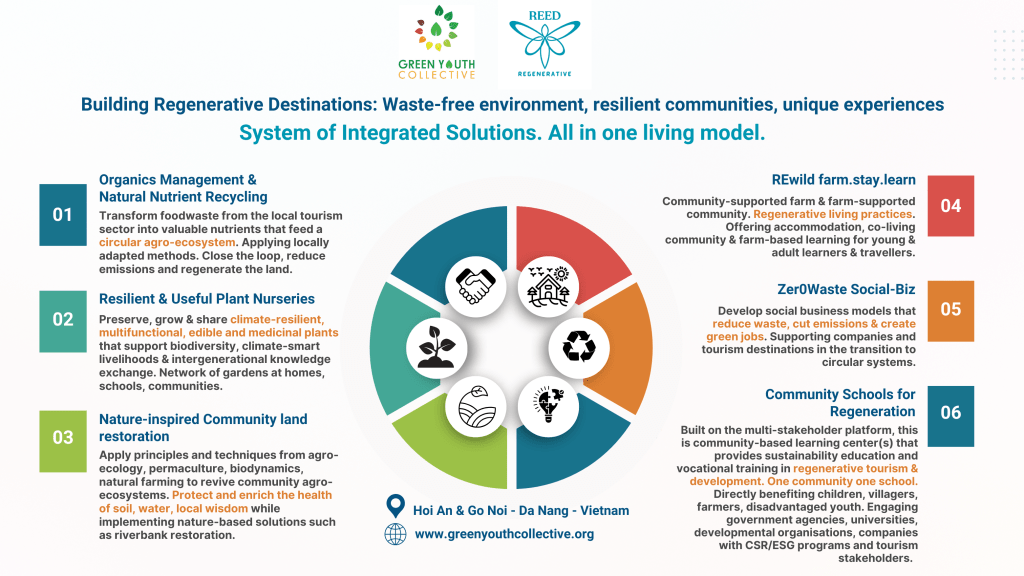
These three strategies are embedded across GYC’s core areas of action:
- Zero Waste & Resource Management
Redesigning organic waste flows upstream, learning from natural decomposition cycles, and building community-owned infrastructure. - Closed-loop Farming & Community Agro-ecosystem Restoration
Applying ecological principles to food systems, riverbank and community land restoration, plant nurseries, and regenerative livelihoods. - Community Schools for Regeneration
Creating learning environments that function like living systems—adaptive, relational, and rooted in real practice. - Regenerative Tourism & Travel with Purpose
Re-embedding tourism within local ecosystems and communities, engaging tourism-related stakeholders including destination-management government, tourism businesses, travel agencies and travellers in place-based project-based regeneration process.
Together, these initiatives form a living ecosystem of action— where each reinforces the others.
6. Regenerative sustainability as a shared learning journey
From GYC’s experience, regenerative sustainability is a continuous learning process, shaped by place, people, and changing conditions.
Rather than scaling identical solutions, regeneration spreads through:
- Shared principles
- Context-sensitive design
- Networks of practice and learning
This is how locally led work can remain deeply rooted—while still contributing to broader transformation.
 Vietnam's Community Schools for Regeneration