At Green Youth Collective (GYC) and REED, we view plastic pollution not as a standalone waste issue, but as a symptom of a deeper systemic problem — rooted in linear consumption models, poor product design, and short-sighted policies.
To navigate this complexity, we draw inspiration from a simple yet powerful metaphor: a river.
The Plastics River: Upstream vs. Downstream Solutions
Imagine the flow of plastic pollution like a river:
- Upstream refers to the root causes — where materials are extracted, products are designed, and consumption is shaped. Interventions here include rethinking business models, redesigning products, and scaling reuse systems that prevent plastic waste from being created in the first place.
- Downstream addresses plastics after they’ve entered circulation: improving segregation at source, strengthening collection and recycling, and minimizing leakage into land and water.
While both ends of the river are important, REED and GYC focus our efforts upstream — where lasting transformation begins.
Redesign: Solving the Problem Before It Starts
One of the most promising strategies for upstream change is product and system redesign.
In 2023–2024, REED served as the technical consultant on the “Phú Yên for Zero Waste” project — a multi-country collaboration led by Vietnamese (GreenHub), Swiss (IDE-E, EAWAG/SANDEC, Urbaplan), and French (IRD) partners. Funded by the cities of Basel and Paris, this project applied design thinking methodology to tackle the overuse of single-use plastics, starting with shopping bags in local markets.
Together with local women shoppers, market vendors, waste pickers, and community-based social enterprises, we:
- Identified the functional roles of single-use bags
- Co-developed durable, reusable alternatives made from discarded fishing nets
- Piloted user-centric solutions designed for real-life habits, not just ideal conditions
These bags are now produced by informal waste collectors and local women, turning plastic waste into livelihoods and showcasing what locally appropriate, circular design looks like in practice.

[Credits for the photos belong to the “Phu Yen for Zero Waste” project.]
Reduce: Shaping Behaviour and Systems
Reducing plastic consumption is both a communications challenge and a policy imperative. While many reduction campaigns focus solely on consumers, the real leverage lies in working across the system — from individual habits to regulatory frameworks.
Our reduction strategy includes:
- Behavioural education: Engaging women in households, students in schools, and community influencers to build awareness and shift norms
- Policy advocacy: Supporting measures like Extended Producer Responsibility (EPR) and the Global Plastics Treaty, which place accountability on producers, not just consumers
Plastic reduction isn’t just about refusing straws — it’s about rethinking the systems that normalize disposability, and disrupting the logic of overproduction.
Reuse: The Cornerstone of the Circular Economy
Among all upstream strategies, Reuse offers one of the most powerful pathways to eliminate single-use plastics.
Defined by the WeChooseReuse platform, reuse systems are those in which:
“Products and packaging are designed to be used multiple times, returned to producers, and circulated within a closed system.”
At REED and GYC, we promote reuse not as a new innovation — but as a return to wisdom. Older generations in Vietnam remember clay jars, metal lunch boxes, and refillable condiment bottles. Reuse is not unfamiliar — we’ve simply let it be displaced by a culture of convenience.
Our closest partner, Refillables Dong Day, has led the way with Vietnam’s first package-free stores in central Vietnam. Customers bring their own containers to purchase home-care, personal-care, and food products in bulk — choosing only what they need, when they need it, without single-use packaging. REED also incorporates the theme of Reuse-Refill as Regenerative Hospitality and Experiences to offer travellers and learners within and outside Vietnam.
In December 2024, REED led the first Reuse Tour in Vietnam, in partnership with Pacific Environment and DietPlastik Indonesia. The tour brought together tourism businesses, local governments, and reuse champions to explore how hospitality and tourism — as high-waste sectors — can become reuse leaders. This is one of the clearest entry points for systemic, sector-wide transformation.

[The diagram is from “The New Reuse Economy” by Upstream, http://www.upstreamsolutions.org]

[The four reuse models are introduced by Ellen MacArthur Foundation]
Replace: It’s Time to Move Beyond Material Swaps
Too often, efforts to “replace” plastics fall into the trap of material substitution — swapping plastic for paper, bamboo, or rice-based alternatives. But a life-cycle assessment reveals the flaws: paper straws, for instance, often emit more carbon and require more energy to produce than plastic straws.
The issue is not what the straw is made of. It’s whether the straw — or any single-use item — is necessary at all.
We advocate for removing unnecessary single-use products entirely, or where necessary, designing for true reuse at scale, not one-off novelty.
REED emphasizes this message across our training and stakeholder engagements:
The goal is not to replace plastic — it’s to replace the culture of disposability.
Recycle: A Last Resort, Not the First Solution
Recycling plays a role, but it is not the silver bullet. Plastic recycling faces challenges of:
- Low economic viability
- High contamination rates
- Material downcycling
- Environmental health risks for informal waste workers
REED has seen this firsthand in landfills across central Vietnam, where even valuable, recyclable plastics are rendered useless by poor segregation and contamination.
That’s why we support door-to-door source segregation, local Material Recovery Facilities (MRFs), and training in plastic literacy — helping people understand what’s recyclable, what’s not, and why it matters.
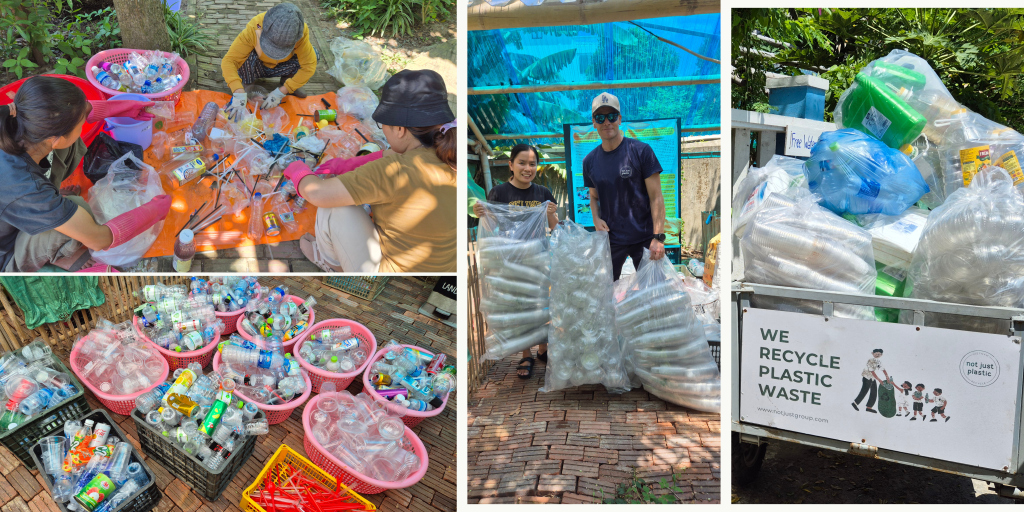
At our Hội An Eco Hub, we run small-scale demonstration MRFs and collaborate with Not Just Plastic to recycle select plastic types from the tourism sector. In our pilot phase, we’ve successfully recovered and sorted over 6,000 plastic items/month for recycling — showing what’s possible with education, community cooperation, and appropriate systems.
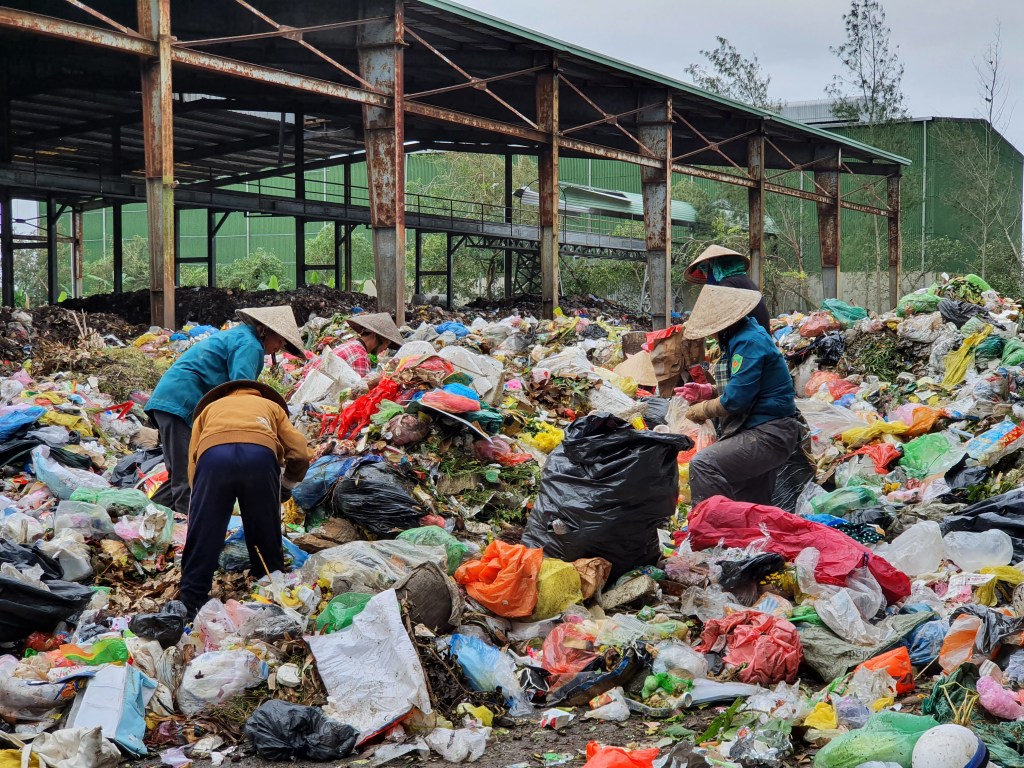
Hoi A landfill. [We just think that everyone working on tourism sector/ development in Hoi An should see – and smell, this picture]
Education: The True Starting Point
Plastic is not just a material — it’s a story of extraction, chemistry, production, and politics.
REED and GYC prioritize plastic literacy as foundational:
- Where does plastic come from?
- What chemicals are added during production?
- Who profits from the current system?
- What are the real environmental and health costs?
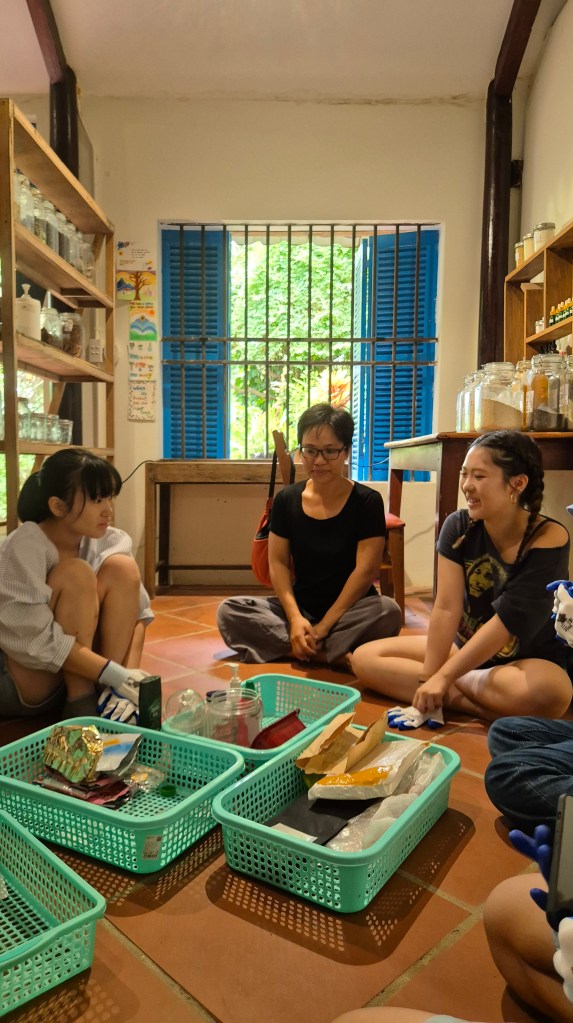
When people understand the true life cycle of plastics, they are far more likely to make informed, empowered decisions — for themselves, their communities, and the planet.
Conclusion: Systemic Problems Require Systemic Solutions
At REED and GYC, we don’t isolate plastics as a waste issue — we embed it within our broader vision of zero waste systems, climate resilience, and regenerative development.
Our message is clear:
- Plastic waste is a design failure, not a disposal issue
- Reuse is a system solution, not a niche lifestyle
- Prevention is more powerful than recycling
- Behaviour change begins with awareness, but lasts through systems and policy shifts
We continue to work alongside communities, governments, businesses, and movements across Vietnam and Asia to ensure that upstream solutions become mainstream practice.
Because the only way to stop plastics from polluting our rivers…
is to stop it at the source.
 Vietnam's Community Schools for Regeneration