
Hội An draws millions of visitors a year to its ancient lanes, rice fields, river and ocean views.
But behind the destination’s celebrated tourist attractions, the communities, farmlands and waterways that sustain Hội An’s heritage are under growing pressure — from climate change, rapid urbanisation and changing ways of living.
Across Hội An and its connected riverine villages in Gò Nổi, Green Youth Collective creates multi-stakeholder partnerships and builds with local communities to regenerate these living systems through practical models in zero waste & local – circular economy, floodplain agro-ecosystem restoration, village-based learning and regenerative tourism.
Our work is to restore the living capacity of local communities and the ecosystem in the context of change.
Watch the feature video
RESTORATION WITH NATURE AND PEOPLE: THE GREEN YOUTH COLLECTIVE STORY
A reflection on more than a decade of learning and contributing to the regeneration of the place we call home – Hoi An, Vietnam.
FROM sustainability COMMITMENTS TO LOCAL OPERATING CAPACITY
Climate, circular economy and ecological restoration commitments only become real locally when people can translate them into services, roles and routines.
An organics programme needs reliable separation, collection, processing and a destination for the recovered nutrients. Reuse needs containers, return logistics, hygiene standards and a viable operating model. Land restoration depends on water, soil, suitable plant material, monitoring and people who will care for the site over time.
These are the implementation conditions Green Youth Collective focuses on. Across the ecosystem, different organisations and local partners take defined roles in operating services, testing models, hosting learning and building evidence. The work connects waste materials, food, soil, water, land, livelihoods, education and tourism where those connections can be made practical.

why regeneration matters for hoi an – and other tourism destinations
A heritage destination is more than the place visitors see.
Hội An’s future depends on the rivers, floodplains, farms, villages, biodiversity, local knowledge and livelihoods that sustain life beyond the Ancient Town. These systems are under growing pressure from climate change, rapid urbanisation, waste and plastic pollution, biodiversity loss and the decline of traditional ways of livings.
Protecting individual sites or organising occasional green activities cannot address pressures that move across an entire landscape. The deeper question is whether the destination can restore its capacity to adapt, care for its resources and renew the conditions on which both community life and tourism depend.
what we do: working models
Tourism destinations do not lack sustainability commitments. The real challenge lies in the lack of practical systems that turn those commitments into everyday operations and change that lasts.
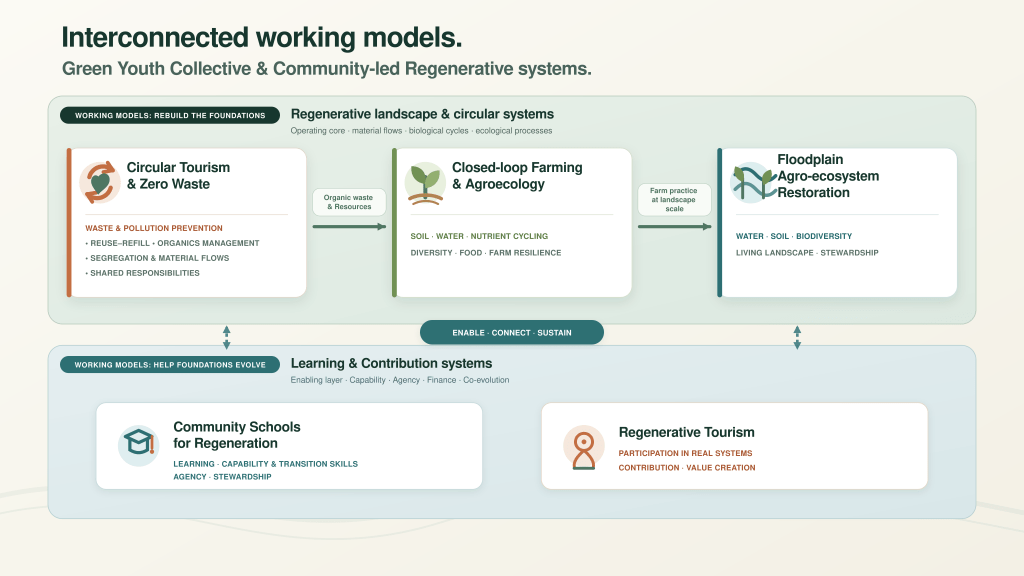
The five Working Models show how GYC and its partners translate ideas into practice. Each addresses a different part of the local system while contributing knowledge, resources or operating capacity to the others.
Circular Tourism & Zero Waste
Helping tourism destinations and hospitality businesses prevent waste, recover resources locally and build operating pathways for Reuse-Refill, Organics and responsible material recovery.
Floodplain Agro-ecosystem Restoration
Restoring ecological processes, riparian vegetation, climate-resilient plant diversity and community stewardship that enable the working floodplain to adapt and to regenerate.
Closed-loop farming & Agroecology
Returning nutrients to soil-plant-animal system on farms, reconnecting farming, food systems, biodiversity and local livelihoods.
Community Schools for Regeneration
Turning operating sites, local knowledge and practitioners as a living curriculum. Learners engage with work that is already taking place and develop skills relevant to ecological and social transition.
Regenerative Tourism
Designing travel and hospitality programs so they contribute to the well-being, capability and resilience of the places and of communities on which they depend.
who we are
A Vietnamese ecosystem of organisations and places, each with a distinct role, started and connected by Green Youth Collective.
Together, we turn regenerative mindset & ideas into systems that local communities can operate and adapt over time—demonstrating how local actions can address global challenges.
places Where we work: Regeneration in practice
Our places are working models rooted in the communities around Hội An. Each responds to a real local challenge while building the knowledge, skills, relationships and systems needed to care for that place.
Together, the places where we operate community-led solutions form a distributed Community Schools for Regeneration—where local practitioners, youth and women, farmers and workers, tourism businesses, authorities and visitors learn from real systems in action.
Hoi An Medicinal Garden – Triem Tay village
Close to Hội An’s center. A community garden connecting useful plants, local knowledge and skills of using plants for everyday well-being, and biodiversity.
Hoi An Eco-Hub: Community Zero Waste Center – Cam Kim
Close to Hoi An’s center. An unique public-private-community project on zero waste in Vietnam. A community operating infrastructure connecting source separation, material recovery, organics in closed-loop, reuse-refill, zero waste education and lifestyle, and tourism-sector engagement.
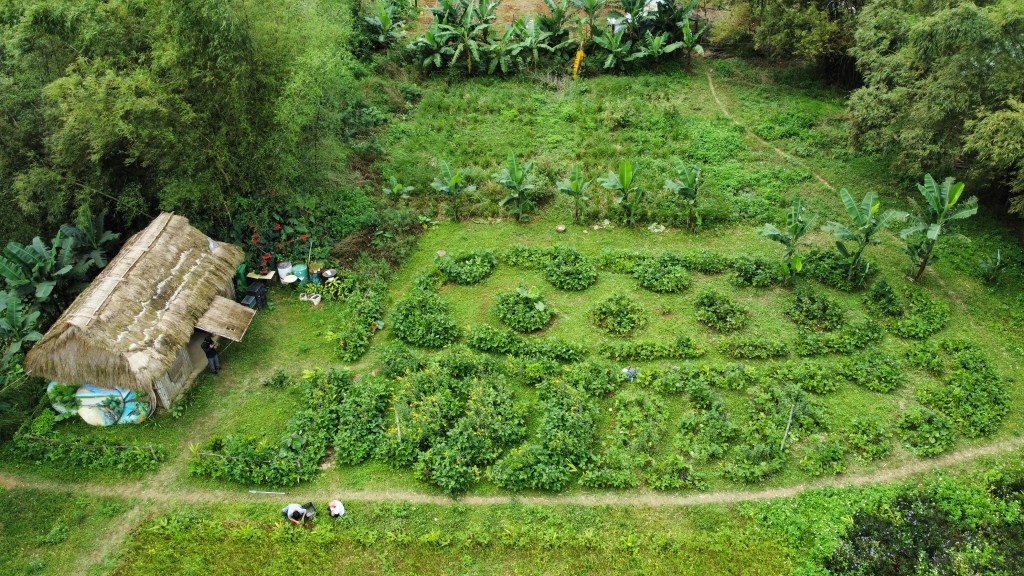
REwild Land restoration farm – Cam Phu village, Go Noi
15 km from central Hội An, within the farms and homes of a traditional village.
Two connected working areas bring together floodplain agro-ecosystem restoration, closed-loop farming, agroecology, community stewardship and a village-based hospitality model.
Together, they explore how caring for land can support learning, real food, livelihoods and meaningful travel.
impact: what change looks like
We build for changes that can last: public-private-community actors join partnership, businesses change operations, discarded materials return to use, land remains under active regenerative care, and local people hold meaningful paid roles. These selected figures show what has begun to shift—and what we continue to operate, test and strengthen.
insights: thinking from the ground
Practice challenges the questions we ask. Behind hospitality services, compost piles, farms, gardens, visitor journeys and restoration sites are deeper questions about how change really happens.
These reflections come from years of building and adapting systems in practice—for communities, partners, researchers and institutions interested not only in what we do, but why the work is designed this way.
call for collaboration
We work with governments and development partners, universities, and schools, tour operators and hospitality businesses, researchers, volunteers and travellers who want to engage with real practice of place-based regeneration.
For development partners and funders: Work with us to build local capacity for change that lasts.
For tourism & hospitality businesses: Work with us to strengthen your operations through zero waste approach, purchase natural and ethical food, ESG-oriented impacts & evidences
For schools, universities and educational travel partners: Work with us to learn from local action that makes global issues tangible.
For tour operators, travel agencies, DMCs: Work with us to transform your visitors’ experiences with the meaningful connection with the work needed for local sustainability.
For eco- and health-conscious families and travellers: A healthier, more regenerative life becomes easier to imagine and to redesign when you can live inside it during your stays in Hội An. Experience another way of living with us.
IN THE MEDIA
Selected coverage, interviews and conversations about us and what we do.
“Transformation of the world lies hidden within the undeveloped capacity of every person..
We make a better world by teaching ordinary people practices for shifting their thinking processes and enabling themselves to show up as parents, employees, citizens and neighbours in completely new ways.”
—Carol Sanford, “The Regenerative life”