In many places, waste is still treated as something to be gotten rid of: collect it, move it, bury it, burn it, and push the problem further away from the short-term sign.
In a destination like Hoi An, the waste and plastic pollution has already been a burning issue. Overloading and shut-down landfill, billions of public funds go to paying for the poorly managed mixing and dumping, vulnerabilities of the most frontline community groups remain invisible and unnoticed.
Waste is not only a technical issue. It is also a social issue. Waste and materials directly link to resource management, ‘being wasteful’ is how we are consuming the limited pool of natural resources for the next generations. Waste management system in Hoi An reflects how materials are used, how tourism operates, how communities are included or excluded, and whether local development is strengthening resilience or quietly increasing vulnerability over time.
That is why the Hoi An Community Zero Waste Center matters.
Our new Center is being developed as a community-based, decentralized Materials Recovery Facility (MRF) serving more than 1,200 households and small businesses in Cam Kim area, as well as wider communities of Hoi An. It represents a system designed to support source separation, organic waste diversion, reuse and refill, recycling, youth – community – tourists education, and community participation as part of one connected system.
What Zero Waste really means
GAIA (Global Alliance for Incinerator Alternatives) frames zero waste as a fundamental redesign of how society uses materials. Drawing on the internationally recognized definition it upholds, zero waste means conserving resources through responsible production, consumption, reuse, and recovery — without burning them and without polluting land, water, or air. GAIA also emphasises that zero waste is both a goal and a plan of action. It is about waste reduction, reuse, composting, recycling, industrial redesign, and social systems that are just and inclusive.
That is the pathway we follow.
The Hoi An Community Zero Waste Center is not trying to “manage more waste.” It is trying to redesign material flows so that fewer materials become waste in the first place, and more of what is discarded is recovered, reused, composted, or handled by communities and dedicated business models.
Why this Center matters: it fills the missing middle
One of the biggest weaknesses in waste systems is the absence of a practical middle layer.
Policies require source separation.
Businesses speak about sustainability.
Communities want to explore livelihood options.
Young people and community change agents are ready to lead change.
But too often, there is no working structure that connects these intentions to everyday operations.
That is where this Center plays a different role. It functions as an intermediary infrastructure: a practical layer that links households, tourism businesses, local government, smallholder farmers and land restoration stewards, reuse/refill systems, recycling partners, and community education. In GYC’s wider ecosystem thinking, this kind of platform is part of a broader system of intermediaries: connecting zero waste, closed-loop farming, education, local business engagement, and community-led regeneration.
This is what makes the Center strategically important. It helps turn separate efforts into a functioning system.
A working model
The Center is built around several connected material streams.
First, organic waste. In Cam Kim – a rural part of Hoi An alone, household waste is estimated at around 1,000 kg per day, with more than 60% being organic waste. The Center is designed to redirect this stream through composting and other closed-loop farming solutions, rather than allowing it to remain mixed, landfilled, and methane-generating.
Second, dry waste, especially plastics. Here, the key is not simply collecting more material, but creating cleaner material streams that can actually be reused or recycled. That is why the Center depends on source separation, sorting, pre-processing, and cooperation with businesses willing to do the hard operational work required for more responsible and sustainable waste management. We will also explore a model where residents and businesses can bring sorted dry waste to the facility themselves.
Third, reuse and refill. The Center is designed not only to handle waste after disposal, but to work upstream through a Reuse Hub and Refill Station. That matters because a zero waste system cannot rely on recycling alone; it must also reduce dependence on single-use consumption from the start.
Why zero waste matters for climate resilience
International allies state clear that zero waste should be treated as part of climate strategy. Zero waste solutions are a fundamental part of efforts to reduce greenhouse gas emissions, build resilience, and ensure justice and equity. It is also noted that the waste sector is a major source of methane, and that separate collection and treatment of organic waste is one of the fastest ways to reduce short-term warming.
GAIA emphasizes that zero waste belongs in municipal climate resilience planning because it helps cities cope with real climate impacts. In flood-prone areas, for example, unmanaged plastic waste clogs drains and worsens flooding, public health risks, and recovery burdens. Zero waste systems reduce that risk by keeping materials out of the wrong places and by building stronger community-based response capacity.
Seen in this light, the Hoi An Community Zero Waste Center is not just a waste management project. It is part of the local climate resilience infrastructure.
Why zero waste matters for environment, livelihoods, and social systems
GAIA’s framing is useful here because it does not reduce zero waste to an environmental technique. It presents zero waste as a pathway toward healthier environments, more resilient communities, social equity, and sustainable jobs. GAIA also points out that cities implementing zero waste systems have reduced waste, saved money, and created jobs, while avoiding the harms associated with incineration, landfilling, and open burning.
That wider view is especially important for places like Hoi An.
A good zero waste system can:
- reduce pollution,
- improve air, water, and soil conditions,
- strengthen local livelihoods through composting, reuse, recovery, and service-based models,
- and increase community ownership over how materials are managed.
The project’s own expected outcomes reflect exactly that logic: diverting up to 70% of household waste from landfill, reducing methane from organics, improving local soil health, improving working conditions for waste workers, increasing community ownership, and shifting from end-of-pipe disposal to a community-centered circular system.
Zero waste must include justice — especially for waste workers
Both GAIA and WIEGO emphasize that zero waste is not only about materials. It is also about justice, equity, and who gets recognized in the system.
WIEGO notes that waste pickers play a key role in urban systems: they collect recyclables, reduce carbon emissions, keep public spaces cleaner, and supply recycling industries — often at very low cost to cities. Yet they frequently face low social status, poor working conditions, health risks, and little institutional support.
GAIA makes a similar argument from the zero waste side. It stresses that zero waste must prioritize justice and equity, and that integrating informal waste pickers and waste workers is part of building a legitimate zero waste system. Its recent climate finance guidance goes even further: investing in waste pickers, informal workers, and communities is not charity, but a high-impact climate strategy.
This matters deeply in contexts of plastic and waste pollution.
The people most exposed to mixed waste, contaminated materials, smoke, flooding, blocked drains, and toxic working conditions are often the same people whose labour already helps cities function: waste workers, informal recyclers, low-income communities, women, and other marginalized groups.
A real zero waste transition must therefore do more than divert materials. It must:
- reduce frontline exposure to hazards,
- improve working conditions,
- recognize workers’ environmental contribution,
- include them in planning and governance,
- and support dignified livelihoods within the system.
The Hoi An Community Zero Waste Center already points in that direction. We explicitly aim for improved working conditions for waste workers, stronger community ownership, and meaningful participation by youth and local change agents as core outcomes.
A place people can visit, learn from, and take home
The Center is also important for another reason: it is not only an operating facility. It is a learning and demonstration site.
The project includes education for youth, communities, businesses, and visitors on waste-related emissions, circular economy, source separation, and home composting, while positioning the MRF itself as a place for hands-on climate education. It also includes a Zero Waste Youth Hub and youth-led activities to support long-term behaviour change.
It is a place where people can:
- see how a community zero waste system actually works,
- experience practical activities around reuse, refill, recycling, and composting,
- understand how materials move through a healthier system,
- and leave with inspirations and ideas they can apply at home, in the workplace, at school, and in their own neighbourhoods.
Travel agencies and tourists to Hoi An now have an unique destination to visit, to experience and to learn about Hoi An from a different perspective: not only an UNESCO World Heritage site, but also how cultural heritage and natural beauties are at risk, and how local communities are working together to protect our own home. As visitors to the place, you are all invited to join us in this journey! A must-do when visiting Hoi An!
The bigger point
The Hoi An Community Zero Waste Center is small in physical scale, but large in systemic significance.
It shows that a zero waste destination is not built through slogans, one-off campaigns, or isolated recycling points. It is built through the slow, practical work of creating the missing middle: the infrastructure, partnerships, and community capacity that connect climate goals, material flows, livelihoods, and justice into one operating system.
Not only to manage waste better, but to help Hoi An move toward a model of development where materials are valued, communities are included, vulnerable workers are recognized, and resilience is built from the ground up.
The Center is a part of Green Youth Collective & Community-led Regenerative systems, and Travel with Purpose program.
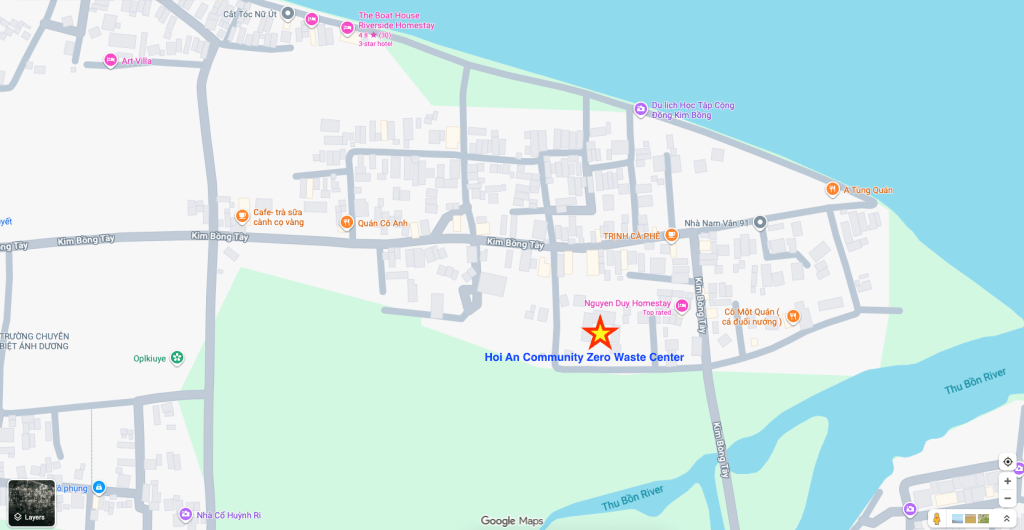
Update on the location part: we are trying to update the Google address on map. Meanwhile, the Center is located behind “Nguyen Duy Homestay” on Kim Bong Tay street, Cam Kim side of Hoi An.
 Vietnam's Community Schools for Regeneration