REwild Farm.Stay.Learn Hoi An = REwild Parenting + REwild Farming + REwild Community
A living system within Green Youth Collective & community-led regenerative systems
Since humanity walked into 21st century, for over the past two decades, education has changed dramatically—at least on what we can see in the eyes.
We talk about soft skills, critical thinking, holistic education, wellbeing. These ideas have become mainstream across schools, programs, and parenting conversations. And yet, if we look closely at reality, a persistent paradox remains: children are more anxious, parents more overwhelmed, and communities increasingly fragmented.
So the real question is no longer whether education has evolved.
It is whether we are slowly transforming education—or simply rephrasing it.
Much of what is framed as “innovation” still operates within the same underlying logic. We package life skills—communication, collaboration, emotional regulation, critical thinking—into teachable content, and deliver them through structured programs. But these are not subjects like math or language. They are capacities that emerge through lived experience, through relationships, through context.
Research from the Harvard University Center on the Developing Child has consistently shown that human development is shaped not by what is taught, but by the quality of ongoing, responsive interactions between a child and their environment. In other words, children don’t learn how to live from instruction—they learn from the ecosystems they inhabit.
And that ecosystem is far larger than school.
From the perspective of Ecological Anthropology, a child develops within an interconnected system of family, community, culture, livelihood, and natural environment. When that system is reduced to a classroom, a busy schedule, and a screen, it becomes almost impossible for complex human capacities to develop organically.
What makes this more challenging is a quiet but widespread assumption: that education can be outsourced. Many parents, even highly conscious and well-intentioned ones, place their trust in “good schools” or “advanced programs” to take care of their child’s development. But schools—no matter how progressive—are only one part of a much larger system. If the broader living environment is misaligned, no curriculum can compensate for it.
Even alternative education models, while valuable, often remain limited if they function as isolated experiences. A child may spend a few hours a day in a different kind of learning environment, but the majority of their life still unfolds within the same unchanged system. Without a shift in the ecosystem itself, impact remains partial.
At a deeper level, what we are facing is not simply an education problem. It is a systems issue. A breakdown in the relationship between humans and the living systems that sustain them. People are increasingly disconnected from land, families from communities, children from nature, and education from real life. In that context, adding more “skills” or “methods” is unlikely to address the root cause.
This is where a parallel shift from the sustainability field becomes relevant. The movement from sustainability to regenerative development reframes the goal—not as reducing harm, but as designing systems that enable life to continuously evolve and regenerate. As articulated by Pamela Mang and Bill Reed, the focus shifts from creating better products to cultivating the capacity of living systems to grow, adapt, and co-evolve over time .
If we apply this thinking to education, a powerful question emerges:
Are we designing programs, or are we designing living systems for human development?
REwild Farm.Stay.Learn Hoi An was born from this question.
REwild is a living system—one that reconnects elements that have been artificially separated.
At its core, REwild integrates three dimensions:
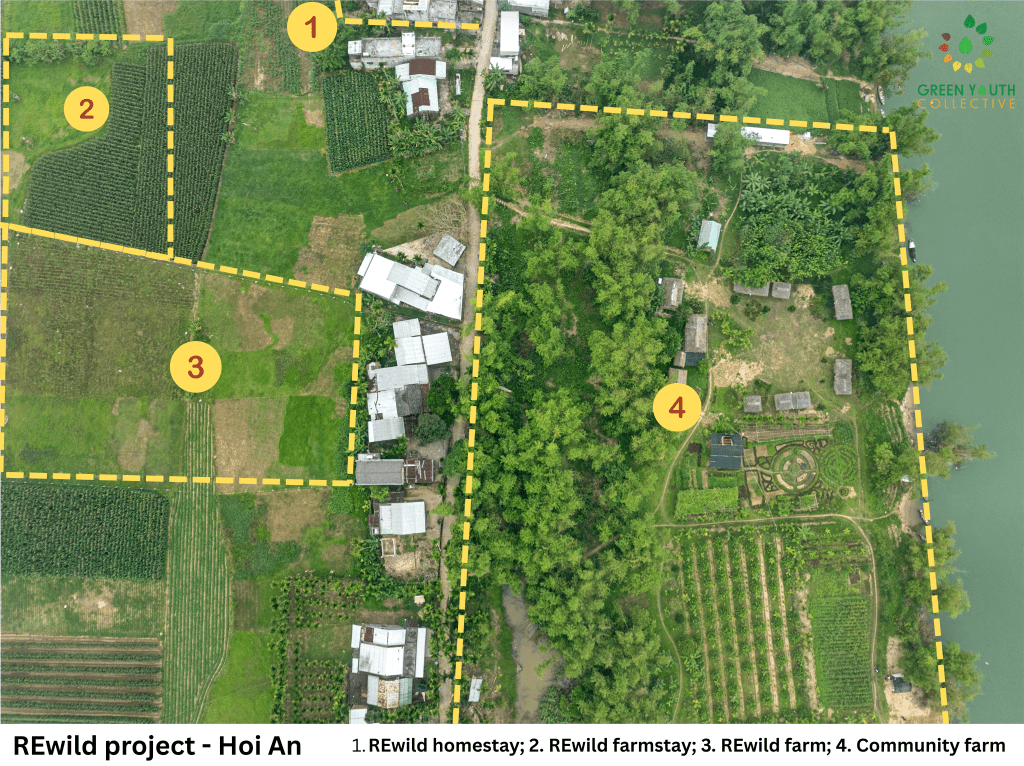
REwild Parenting brings parents back into the center of the developmental ecosystem. Not by offering yet another method, but by creating spaces for parents to learn, reflect, and evolve together. Parenting becomes a shared practice within a community, rather than an isolated personal responsibility.
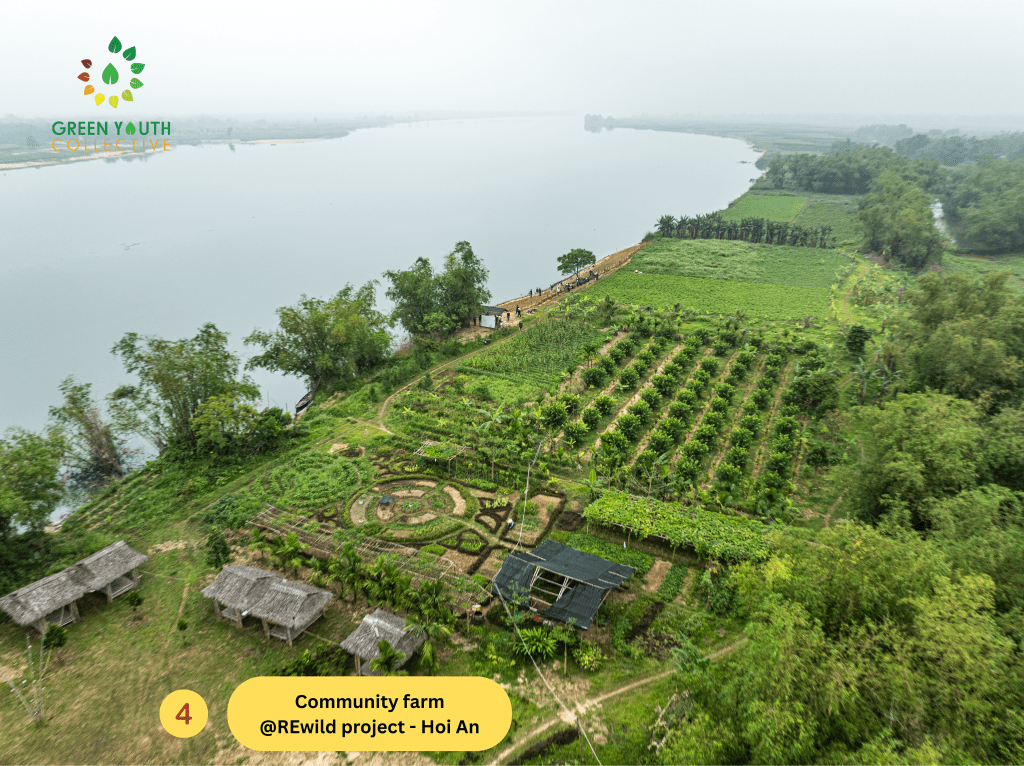
REwild Farming reconnects learning with the fundamental cycles of life—soil, water, food, waste, regeneration. Children do not learn about sustainability as an abstract concept; they experience it directly, through participation in living systems where their actions have visible consequences.
REwild Community bridges intentional communities—families, educators, and changemakers who choose to live with awareness—with traditional village communities that carry local knowledge, culture, and livelihood systems. Rather than creating isolated “ideal spaces,” REwild fosters a dynamic exchange where both worlds learn from and strengthen each other.
These three dimensions are not separate initiatives. They form an integrated ecosystem—where education, parenting, livelihood, and environment are deeply interconnected.
REwild Farm.Stay.Learn Hoi An exists within the broader ecosystem of Green Youth Collective, where regenerative practices are implemented in real contexts—from zero waste systems and circular resource flows to regenerative farming and community-led development. Here, community members are not passive recipients of solutions; they are active co-creators of the systems they live within.
The most important contribution of REwild is a shift in perspective. It challenges us to move beyond the question of “what should children learn?” and toward a more fundamental one:
What kind of world are we creating for children to grow into?
If that world remains fragmented—disconnected from nature, from community, from meaningful participation—then no educational reform will be sufficient.
It takes a village. But more importantly, it takes the commitment, resilience, capabilities to rebuild that village—intentionally, collectively, and in alignment with the living systems we are part of.
As parents, farmers, educators, community leaders and founders of REwild Farm.Stay.Learn Hoi An, we started this journey almost 20 years ago, from building place-based regenerative sustainability knowledge and capacity, to having our own children and practicing these values everyday now – and we are in the progress of evolving the systems altogether. Will you join us?
 Vietnam's Community Schools for Regeneration